Showing posts with label #marketing. Show all posts

Friday, August 14, 2015

Using Technology For You

Most of us feel that technology intrudes on our life, especially in the area of work life balance. There is an expectation to respond to seemingly endless alerts and messages that come through. We have a range of apps that need continuous updating. Rather than technology making life simpler it feels like it has created more distraction, even demands in our life. 

I have spent a lot of my career understanding what 'convenience' means in our busy lives. The shift over time has gone from 'options' to 'simplify'. In other words people were looking for more options to suit their needs and lifestyle resulting in more solutions and choices, which has switched to a current need to prioritise and focus. We are feeling overstimulated, unable to keep up with the latest, struggling to identify what is best for us.

I thought I would share in my next few blogs some ways that I am using technology to help simplify my life and help me focus on things that matter. What prompted all of this has been a focus on 'mindfulness' amongst my friends and colleagues. Feeling the need to be more mindful in how I go about my days, the first thing I thought was I must download an app. The reality for me though is that's where a lot of my good intentions for using technology for my personal benefit end. An app downloaded which I use once or twice. Why?.. I need an app to remind me to use the app. 

I rethought what makes sense for me. Here's some smart phone tips I have used to be more mindful in achieving personal goals. Given they are making a difference for me I wanted to pass on.

1) Use the location setting in reminders on your iphone: I have used this as a simple pop-up 
reminder when I am at home or work to do something. It works for me because it happens automatically when I arrive somewhere. I can take action at the place it needs to happen. It's a great way to set up a new ritual eg. pack gym bag, take vitamins. Even for personal reflection questions  eg.  You're home now are you present?, What did you  learn today? Or List the top things you want to achieve this week

2) Get to know Siri or use voice messages: Apart from saving time, it's quick and easy to talk to Siri or dictate to get things out of your head. You can save your thoughts and know that you won't lose them. Siri is great for setting reminders too with little effort. 

3) Use emojis, photos, music, memes: Make your personal goals stand out by using visual or audible cues. It makes them more fun. I use the location reminder at the gym when I leave to bring up a 'Wow I regret that workout said no-one ever' message with a happy face. It always makes me smile. 

4) Turn off notifications and/or use the Do Not Disturb feature: Create less distractions by managing phone notifications.  Under the setting menu on iPhones you can go into notifications and choose by app which ones you want to receive notification updates for and more importantly whether you want to see them on the lock screen. You can also put your iPhone on Do Not Disturb manually for a short period of time so you won't receive messages or you can schedule times in. You can allow calls from certain contacts, for example your family members, in case of emergencies. These are great features to utilise when you are wanting to focus without interruptions.

5) Group apps together and/or move them into the quick reference bar at the bottom of the screen: if you downloaded an app or apps you want to use for personal goals group them together and place the group along the bottom bar of your device. It will remind you of your goals as they will be in sight often. It may also help you use these, especially when you first download. 

These are just a few ways I am using my smart phone in a smart way to be more focused. I'm sure there are many other creative and clever ideas out there. I would like to hear about any other ideas you may have.  Please let us all know.


Saturday, October 11, 2014

The Great Talent Trade-Off


The global financial crisis has seen a reduction in team sizes, flater structures, and a focus on short term results. This has impacted on how talent is recruited and developed. Acquiring resources that make an immediate impact and are given a remit to 'act and ask questions later' is a trend.

In this current over stretched and activity driven business landscape, the process of developing people through mentoring and coaching is a distraction. Over burdened managers and team members do not have the time to do this well.

So where does this leave talented resources who want to learn and grow. I have seen many people thrown into the 'deep end' who rise to the surface displaying skills they did not even know they had. In these cases, it has mostly been a combination of personal tenacity, coupled with informal coaching and support that has fast tracked professional growth.

Resources that have development needs are missing out on quality informal support networks due to the stress on manager workloads. The outcome being a rush to recruit 'new' rather than enhance 'existing' skills. Given the cost, risks  and lead time of external recruitment this seems like a false economy.

Business leaders indicate that finding and managing talent is one of the biggest; if not the biggest; organisational issue and opportunity. Having resources with the right capabilities, attitudes and experience is a key success enabler. One dissenter, aggressor or saboteur can impact on a team's performance, morale and dynamics. The risk of this increases when new variables are thrown into the mix.

Learning theory states that the more frequently we perform a task, gain experience or apply knowledge the more adept we become. Many younger or developing professionals are finding that time, patience and tolerance for error needed for growth is a scarcity. Being 'tagged' specifically by the job function they perform rather then the potential abilities they possess.


Most managers indicate that they don't have time to manage people, let alone develop people. There is a lot of pressure on team leaders to performance manage individuals and significantly less focus on development. This is a symptom of the current business climate where people management is part of a job function and not a specialised competency.

Short term, high impact resources have come to be seen as the solution. However, when this solution is applied too often it can damage team performance. Causing disruption, frustration and even friction as teams attempt to move quickly while adjusting to change and pushing for results.

It takes time in any new organisation to learn how 'things are done' and effectively build internal networks to influence outcomes. Even highly experienced resources coming into a new organisation need to navigate decision politics and build influence. So the ability to make an immediate impact can be stifled. These resources too can suffer from a lack of internal guidance and coaching.

Bringing in new perspectives and skills is necessary at times. At other times it's a catalyst for disaster. While immediate results are the ultimate aim, these are hindered by changing group dynamics and lack of internal process experience. 

Existing resources that are dedicated, hardworking and willing to learn can excel in stretch roles with the right coaching. They have the advantage of established internal networks and trust. In short, they will get things done. Channelling existing talent into appropriate development roles would reduce recruitment costs, staff turnover and time wasting. It will build a learning environment and motivate current staff to excel with promotion in mind.

Getting the right mix of established and new talent requires considered thinking. People Managers have many time pressures, giving them little time to focus on others in their teams. So naturally it seems expedient to look for team players that need little guidance or direction.

Yet where does this leave individuals with potential who want to learn and grow. These resources can miss out on receiving the attention of their line managers for informal and formal mentoring. Is the desired outcome of minimal involvement for quick wins really holding true as managers struggle to do just that - manage people.

I can't help but ponder... managers are too busy to manage and resources need to be 'ready to roll.'

Are we making talent assessments based too much around short term needs?

Is there a section of the workforce missing out on developing professionally through informal support networks?

Is the cost vs benefit stacking up?

Is this a time of short term talent trade-offs that will have long term impacts on individual and team performance?

What do you think?

Thursday, April 24, 2014

Campaign or Content Brief


There are two ways to look at a communications brief:

1) Develop a campaign concept 
2) Create 'campaign-able' content

A campaign approach is single minded and targeted. All materials produced fit together under a theme, style and narrative. Reinforcing key messages in a relevant conceptual framework. This is how most communications briefs are approached. 

Here's the thing about always approaching communication briefs as a campaign - content repurposing is often limited by the boundaries set in a campaign approach. So while it is recognised that a lot of content exists within organisations it is hard to stretch across media channels. A lot of one-off communications pieces exist that could be utilised 'if only'. 

In a multi-media age, a fresh approach to communications briefing where campaign-able rather than campaign is the 'big idea', can generate content with a purpose to repurpose.
This requires a flexible approach to production and creative thinking to dial up messaging for a specific audiences.

As corporate messaging becomes more responsive, I feel that communicators need to shift their thinking to be more like direct marketers in many ways.  This is a big mindset change. Direct marketers trial audience response and use these learnings to tweak content to optimise impact by media, segment and behaviour. They also publish the same or similar content pieces more than once to reach a wider audience, as they recognise that an audience base grows and timing impacts our responsiveness.

This is where a 'campaign-able' content approach comes into play. Content can be integrated into communications programs, it can be re-run with a new context, it can be shared, commented on, and reworked to increase cut through over time. It becomes content rather than campaign materials, and is therefore an asset that can be leveraged over time.

Here are some suggested asks to place into an internal or external communication brief to generate a content approach:


  • Demonstrate how the content could work in various media layouts, events and publication styles
  • Allow for customised changes in the creative production that can be done in a timely and cost effective way
  • Consider what format the concept would take if peer to peer sharing was an objective
  • Explain how the content produced could be repurposed? Which audiences, where and how?

Content may be king, however you don't want it to have a short rule in a small closed off kingdom.


Tuesday, April 22, 2014

The Pursuit of Marketing Excellence


The pursuit of marketing excellence is a journey of discovery, territory expeditions, and sharing experiences. Like all great adventures, it is the twists in the tale that capture our imagination and stick in our memory. We learn as much from the chase as we do from the conquest.

A marketing culture that champions excellence has evidence of robust processes and information exchanges; all done under the umbrella of an aspirational internal positioning of marketing pursuits. 

What evidence of excellence would exist?

- details on ROI (return on investment) and/or ROO (return on objectives) are identified upfront
- is insight driven when formulating approaches
- NPD (new product development) has the customer in mind
- openly shares strategy and campaign development
- documents execution and performance
- trials and tests, learns quickly
- is flexible about changing direction based on test data
- keeps pace with new media, distribution and technology impacts
- actively exchanges ideas and best practice across brands and markets
- keeps watch on the external environment
- invests in training and access to experts 
- recognises and rewards excellence 
- builds informal marketing networks that lead to collaborative solutions 

What can really ignite Marketing Excellence is positioning it right. After all the words marketing and excellence together are powerful. Like any impactful campaign the 'call to action' must cut though and be memorable. 

Reflecting the desired marketing qualities in messaging, events and programs reinforces what the pursuit of excellence is all about for marketers. It will bring them on the journey. Marketers can be a tough audience to engage because they know all the gimmicks. 

The principles that I work too for engaging a marketing audience are:

- celebrate all things marketing - that is give it the spotlight (obvious maybe, but often not done)
- surprise and delight (don't do the obvious eg. Show the viral campaign that everyone has seen)
- always have  a theme for marketing excellence (shake it up every year)
- create energy and fun (not funny, marketing is a serious pursuit, it important not too make fun of it)
- champion the marketers and their campaigns 
- bring an external voice and/or perspective
- create some challenges and competition
- create a way of sharing learning, approaches and success stories 
- start an internal word of mouth campaign to build awareness and interest
- peer to peer is powerful
- bring the 'rational', bring the 'emotive'
- marketers respect clever creativity and messaging

In the pursuit of marketing excellence realise that there is always a new way forward to explore and test. The destination may not always be clear, however the experience is always worth the journey.


Saturday, April 19, 2014

Confessions from client side


Having managed the creative design process on client side for a number of years the reality is that visual work is viewed and commented on by many inside an organisation. Compare this to many other functions where work outputs are mostly shared with one or two others at the most who are usually subject matter experts. This means that working in a corporate role with creative responsibilities is exciting and confronting all at once.

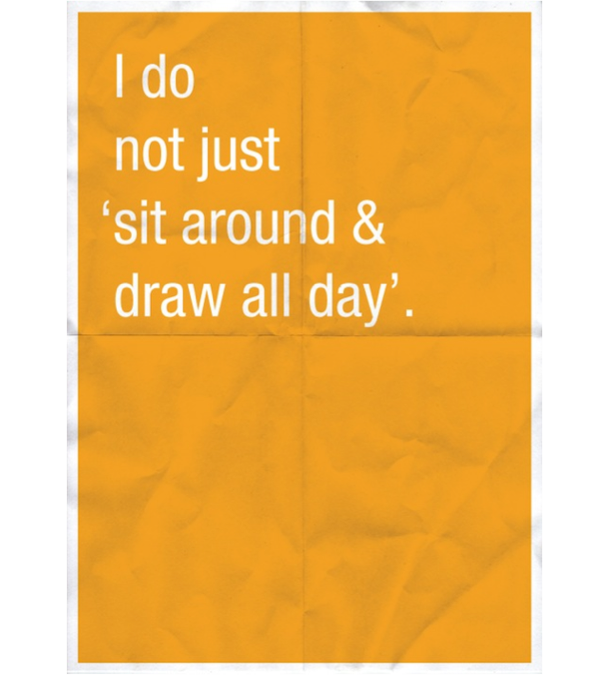
Earlier in the year I came across a fun post on designtaxi.com. It showed a set of posters developed by a London designer called Anneke Short which portrayed the frustrations and realities that designers often face. A frank and comical insight into the challenges for a designer in the creative process when it comes to briefing expectations and perceptions.

I thought it would be fun to show the client side perspective. So here it is - Confessions of a Corporate Professional, what really goes on in a Brand Managers Mind.


Designer
Client


Yes, as clients we need and love to see the corporate or product logo. We are obsessed with it. Deal with it. It gives us reassurance that the design concept will work and we can show it to senior execs. I have seen so many great ideas for packaging and/or advertising get thrown out just because the logo was not visible or treated with care.


Designer

Client


Clients are paying for concepts and ideas. We are hoping that you can come up with them fast so we can get a quick idea of whether one of them is 'on track'  to move forward for approval. After all, we have a lot of stakeholder expectations to manage. A lot of the time our internal colleagues don't know what they want or how to articulate what they need creatively.

Clients are often not open about their motivations when they make a request like this. They do not want to admit they do not know what they or their internal stakeholders are wanting.  A good client requests this when they are trying to get an understanding of what their internal clients want and will share this information up front with the agency. This leads to the point that often clients and agencies enter into the full creative process when really it would be better to explore ideas ...rarely this happens.


Designer
Client


A lot of clients are not experts in creative techniques, production, the concept of studio management or creative software. They have no idea how long something takes to do or how hard it may be. If you then take into account that this is multiplied by the fact that there are internal clients requesting creative work with even less knowledge of these considerations, expectations of efficiency and timings become clouded.

While clients often want 'what they ask for, when they want it',  it is still worth spending the time to explain or identify the process up front. Assisting clients to manage expectations with their internal stakeholders and educating them to be confident to talk about the process helps them be a good mediator when necessary. It will also help them to positively position the design expertise and convey processes.


Designer
Client


Most clients have little choice about the technology platforms they use. In fact in large corporations 'fitting in' rather than 'standing out' is expected to a degree. The ability to put business success first rather than personal agendas.

Believe me, creative people from agencies are often intimidating to clients because they are perceived to be cool trend setters.

We know what agency professionals think of us corporate clients .... we are like PC from the famous MAC and PC campaign. You see us as uptight predicable conformists. This makes us feel slightly awkward around you, because we need to be restrained and considered in our thinking, even if we want to be more daring.


Designer
Client


This would be very frustrating for a designer. You would be amazed at how many clients secretly think they are creative because they have software at hand. Good clients know what their role is in the creative process which revolves around project management, relationship building, influence and professional credibility.

Seriously would a client ever say 'I know my way around a spreadsheet, so send me the budget and I'll play around with it.' It is assumed that there is financial expertise and planning inputs which have been utilised to derive the final version. Yet we often devalue creative work by playing around the edges and losing sight of the discipline needed to produce outcomes.

Designer
Client


Again this perception would be frustrating for a designer. Here's where it comes from.  Clients and their internal stakeholders do not think conceptually or in creative terms most of the time. We spend our days talking about business and industry activities and challenges. So when a designer talks in creative cliches with little business language the perception is they have little understanding of professional realities.


Thank you to Anneke Short for putting these thoughts toghether. They made me smile as I have had the similar thoughts when dealing with internal stakeholders trying to brief me on their needs on client side.  I hope this helps put some perspective on client thinking.

Saturday, April 12, 2014

Entrepreneurs and Innovators Need Only Apply


There is high demand for entrepreneurs and innovators right now. The race for growth and 'break out' innovation is on as businesses look to future proof offers and grow income streams.

It's a great time for creativity and 'go getting.' New ideas need to prevail despite organisational barriers. Taking a 'leap of faith' into a brave new world is the only option for some organisations with technology changing the playing field.

The future is here now, and the talent gap is widening. Companies are fast-tracking cultural change programs to stay ahead of competitors. The 'shout out' for entrepreneurs and innovators is deafening. It seems to be implied in every job advertisement - our company needs individuals that will help us evolve and grow - Entrepreneurs and Innovators need only apply. 

Establishing a workplace that supports process discipline, entrepreneurial tenacity and innovative creative thinking is a challenging construct. A major leadership engineering task. 

New resources acquired to boldly instigate change coupled with established process enforcers makes for an interesting work dynamic. Motivating individuals and establishing interaction rules needs considered attention. Fostering internal partnerships that collaborate effectively to develop solutions requires progressive management thinking.

Below are some thoughts of management style principles to accommodate the entrepreneurs and innovators that every business is chasing:

  • Champion inquisitive and flexible project management practices
  • Embrace diversity
  • Value and reward contribution 
  • Avoid curbing enthusiasm, direct it towards an outcome
  • Respect areas of expertise and opposing professional strengths
  • Encourage exploring leads/ideas to come to 'own' conclusions
  • Be a behaviour moderator - not conformist 
  • Check robustness of ideas and set clear decision frameworks
  • Navigate cross functional politics and decision hierarchies
  • Be a gatekeeper of ideas that do not lead anywhere - allow quirky thoughts and unstructured processes 
  • Maintain an external focus on the customer
  • Be willing to try new approaches 
  • Make process checks pit stops rather than long endurance races
  • Manage risk, set a tolerance for failure
  • Do not over commit - ensure checks and balances are in place

The call is out for entrepreneurs and innovators.....who answers and who listens will determine future success or failures.


Wednesday, January 1, 2014

Is your marketing plan sitting on a shelf?


Great marketing plans come to nothing if the business is not ready to deliver the actions.

Seems like an obvious statement. The simplest of considerations to take into account. 

Consider these scenarios which you may have seen in play:

- Creative executions with limited media investment
- Communications channel activation with limited resources to drive content and dialogue
- Marketing initiative roll-out without sales engagement/support
- Customer events with no follow up or database building
- Technology not aligned to planned activities/communications objectives
- Marketing planning teams misaligned with product/branding 'go to market' groups
- High production costs, low promotional funds
- Great idea without the internal 'know how' to execute
- An articulate and well thought out plan that sits on the shelf collecting dust

The list could go on. In large companies planning and strategy are often separate groups to the teams that execute initiatives. In small companies, business owners are often 'minute managers' and employees multi-taskers. These two dynamics often mean there is a misalignment on strategy intent and how ready the business is to deliver the actions required to achieve the outcomes. 

Below is a template that incorporates a business ready assessment phase. It requires thought about the changes needed within the business to deliver the marketing plan. It is a process that can therefore be used to prioritise short term tactics or to identify longer term changes needed to achieve goals which can be built into a phased approach.