Saturday, October 11, 2014

The Great Talent Trade-Off


The global financial crisis has seen a reduction in team sizes, flater structures, and a focus on short term results. This has impacted on how talent is recruited and developed. Acquiring resources that make an immediate impact and are given a remit to 'act and ask questions later' is a trend.

In this current over stretched and activity driven business landscape, the process of developing people through mentoring and coaching is a distraction. Over burdened managers and team members do not have the time to do this well.

So where does this leave talented resources who want to learn and grow. I have seen many people thrown into the 'deep end' who rise to the surface displaying skills they did not even know they had. In these cases, it has mostly been a combination of personal tenacity, coupled with informal coaching and support that has fast tracked professional growth.

Resources that have development needs are missing out on quality informal support networks due to the stress on manager workloads. The outcome being a rush to recruit 'new' rather than enhance 'existing' skills. Given the cost, risks  and lead time of external recruitment this seems like a false economy.

Business leaders indicate that finding and managing talent is one of the biggest; if not the biggest; organisational issue and opportunity. Having resources with the right capabilities, attitudes and experience is a key success enabler. One dissenter, aggressor or saboteur can impact on a team's performance, morale and dynamics. The risk of this increases when new variables are thrown into the mix.

Learning theory states that the more frequently we perform a task, gain experience or apply knowledge the more adept we become. Many younger or developing professionals are finding that time, patience and tolerance for error needed for growth is a scarcity. Being 'tagged' specifically by the job function they perform rather then the potential abilities they possess.


Most managers indicate that they don't have time to manage people, let alone develop people. There is a lot of pressure on team leaders to performance manage individuals and significantly less focus on development. This is a symptom of the current business climate where people management is part of a job function and not a specialised competency.

Short term, high impact resources have come to be seen as the solution. However, when this solution is applied too often it can damage team performance. Causing disruption, frustration and even friction as teams attempt to move quickly while adjusting to change and pushing for results.

It takes time in any new organisation to learn how 'things are done' and effectively build internal networks to influence outcomes. Even highly experienced resources coming into a new organisation need to navigate decision politics and build influence. So the ability to make an immediate impact can be stifled. These resources too can suffer from a lack of internal guidance and coaching.

Bringing in new perspectives and skills is necessary at times. At other times it's a catalyst for disaster. While immediate results are the ultimate aim, these are hindered by changing group dynamics and lack of internal process experience. 

Existing resources that are dedicated, hardworking and willing to learn can excel in stretch roles with the right coaching. They have the advantage of established internal networks and trust. In short, they will get things done. Channelling existing talent into appropriate development roles would reduce recruitment costs, staff turnover and time wasting. It will build a learning environment and motivate current staff to excel with promotion in mind.

Getting the right mix of established and new talent requires considered thinking. People Managers have many time pressures, giving them little time to focus on others in their teams. So naturally it seems expedient to look for team players that need little guidance or direction.

Yet where does this leave individuals with potential who want to learn and grow. These resources can miss out on receiving the attention of their line managers for informal and formal mentoring. Is the desired outcome of minimal involvement for quick wins really holding true as managers struggle to do just that - manage people.

I can't help but ponder... managers are too busy to manage and resources need to be 'ready to roll.'

Are we making talent assessments based too much around short term needs?

Is there a section of the workforce missing out on developing professionally through informal support networks?

Is the cost vs benefit stacking up?

Is this a time of short term talent trade-offs that will have long term impacts on individual and team performance?

What do you think?

Thursday, September 4, 2014

If You Want To Influence Outcomes Close The Loop

At a time when professional schedules are rushed,  the simple art of following up to 'close the loop' is a powerful influencing technique. Highly successful sales people make this an art. They carefully craft each communication to reinforce they value the relationship, understand the rules of engagement and are committed to being of service as required.  They always thank their contacts for their time and contribution before the chance of a sale has been established. They build credibility from the outset by demonstrating professionalism, interest and efficiency.

While this is well recognised in sales roles where customers are concerned, it is often not the case when it comes to internal relationships. This is a missed opportunity to engage others and gain an increased level of influence. In the same way as getting on the agenda gives you a voice in a large organisation, the process of 'closing the loop' gives you integrity.

I felt compelled to write this article because I feel that professional courtesy is something that is slipping away in the current climate. The reason for this is that we are all doing more with less due to limited  funding, resourcing and time. The professional polish in how we interact in the workplace has eroded, representing an opportunity to influence through attention to detail.

The reality is that any business outcome is accomplished through relationships. Placing an importance on 'closing the loop' will make you stand out. You will become an influencer because you will be seen to be respectful of others, action orientated and in control.

My top  'Closing the Loop' tips for internal consulting are:

1) Send out a follow up email after a meeting you are running to all participants - How often do people go to the trouble of preparing an agenda for a meeting, yet don't take notes during or do any follow up post the meeting. Simple?...the extra follow up can feel like additional time when you are busy, however anything that is documented and shared is more likely to get done, it saves time down the track as a way of tracking actions/decisions etc.

2) Always do what you say you will do - Action what you have promised to do and let the appropriate people know it's done. Simple?....yet we often do we forget to let others know the action is complete.

3) Thank people for their contribution, in an authentic way - It's not hard to thank some-one. The most powerful 'thank you' is one that is short and specific. There does not need to be awards, just a simple recognition that a thought, action or behaviour was appreciated. It demonstrates to the recipient that what they are doing is not going unnoticed. Simple?... rarely done effectively in follow-up communications and 'thanking as you go' is a difficult concept for many.

4) Position key stakeholders - A big mistake in 'closing the loop' is to leave out important stakeholders, even though their direct contribution may not be as obvious.  Influencing is about identifying the most effective way to achieve an outcome. Always position key players and decision makers in any communications.
Even ask yourself if the communication piece should ideally come from them.  If this is the case, make it easy for them by being a 'ghost writer' and compiling a draft.  Simple?...some may feel they lose influence doing this, on the contrary, it demonstrates a clear understanding of politics, process and accountability.

5) Right tone and place - Assess the right tone of follow up;  informal vs formal, dialogue vs action list, light hearted vs serious. You can be creative about how you 'close the loop' and find ways to cut through the communications clutter. It is good process to imprint your professional style on. Simple?...how often do follow ups just become email clutter or action list wallpaper.

If you want to influence outcomes CLOSE THE LOOP. It works. It is an art form and stamp of your professionalism and integrity.

Saturday, August 9, 2014

Quiet please I'm thinking


I have been reading the book 'Quiet' by Susan Cain who raises the question how did we go from Character to Personality without realising we had sacrificed something meaningful along the way.

That 'something meaningful' where space is provided to process, create and be productive. Where quiet reflection is valued as highly as group interaction.

That 'something meaningful' where thoughts can be internal for a time before they are shared. Where group thinking and consensus does not allow the opinion of a few to dominate.

That 'something meaningful' where shouting is not required to be heard. Where deep thought is as important as making a statement. Where diversity includes room for introversion as well as extroversion.

In the noise that exists in work and life, through shared experiences, group activities and team connectedness, there is limited attention given to the need for 'quiet.' Solitude and thinking independently are not negative behaviours. An intense focus on a problem can deliver creative solutions. We need to find ways to enable this and not take away from the contribution of those who need to break away from the group noise to find their own thoughts.

One thing is for sure, there is more noise than ever before. A no other time has self expression been more accepted or encouraged. As pointed out in 'Quiet', the on-line space has created an even playing field for introverts to promote and share their ideas, without the restrictions or difficulties they would encounter in group situations.

The book 'Quiet'  is a voice for introverts, more importantly it challenges the popular views on how we should interact and work together. It is true that extroversion is admired and has become the default preference for how we operate. Extroversion can be trying when there is too much of it, and even demoralising if you find it difficult to speak up.

Finding the balance is key for break through thinking, work satisfaction and personal development.


Friday, June 20, 2014

A Dynamic Approach to Structuring Marketing Teams


Consumer behaviour and how we communicate has changed. In response, business leaders are reshaping marketing teams. In this period of adjustment, ambiguity around the role of marketing is growing as various structural models are being trialled.

"People shop and learn in a whole new way compared to just a few years ago, so marketers need to adapt or risk extinction." 
Quote Brian Halligan, CEO Hubspot.

There are various views and expectations around how marketing teams should operate and what they are responsible for. The mix of competencies required and structural fit is up for debate. 

Emerging areas of expertise, big data analytics and socialisation of communications requires new competencies. While marketing effectiveness becomes more and more interwoven with technology, the structural frameworks are still evolving.

Consider just a few areas of thought impacting the structural design of a marketing team. Considerations such as:

- Should digital and social media expertise be integrated into existing roles or defined as a specialised skill set?
- Do the skill sets sit in an area of marketing excellence or in other functional areas within the business?
- Are marketing services shared or divisionalised?
- Where does expertise for communications, marketing technology and creative services sit?
- What does the term Marketing mean within the business relative to Sales and Corporate functions?

There is clearly a need to adapt quickly and be flexible in determining the most effective structure. The challenge being to ensure that the rest of the business is clear about the model 'in play.'

Roles are emerging within marketing with newly created titles and areas of focus. These roles come and go, and are distinct from the expected disciplines. The result is  that marketing is perceived as an area of unrest, always chasing the latest fade rather then making a proven contribution. A real problem for positioning the area in the short term. 

Also, within organisations the need for effective communications and design is required by a range of departments. Skill sets that were once the exclusive domain of marketing are in high demand across organisations. This can lead to resources being distracted from an external focus and being over stretched. Diluting the effectiveness and single minded focus of marketing teams.

Initiatives such as employee branding, talent acquisition campaigns, corporate issue management via social channels, internal social network building, influencer blogging, on-line content generation - all require talents that traditionally sit in marketing areas. Structural considerations need to recognise this trend and dynamic.

Marketing leaders must be quick adaptors and comfortable with structural 'trial and error' to achieve optimal team performance. Bringing other parts of the organisation into the loop as the group reinvents itself is necessary to overcome the ambiguity created by change.

Marketing skills are needed more than ever across business disciplines to improve communications and implement creative solutions. This high internal demand requires a structural model that enables a balance between creative service expertise and 'go to market' initiative.

This all results in the credibility of marketing being under question - adapt or become extinct. Marketing leaders therefore need to focus on clearly articulating their vision,  what they do and don't do, and how this will deliver on the business plan.


Marketing groups that can not adjust, reinvent themselves with a clear vision of success, and structure with a purpose (even if this changes often) will lose organisational effectiveness. 

It seems crazy to be asking ourselves What is Marketing? 

What's your biggest challenge in building credibility for the marketing function? 

What lessons have you learnt in trialling new structural models?

Thursday, April 24, 2014

Campaign or Content Brief


There are two ways to look at a communications brief:

1) Develop a campaign concept 
2) Create 'campaign-able' content

A campaign approach is single minded and targeted. All materials produced fit together under a theme, style and narrative. Reinforcing key messages in a relevant conceptual framework. This is how most communications briefs are approached. 

Here's the thing about always approaching communication briefs as a campaign - content repurposing is often limited by the boundaries set in a campaign approach. So while it is recognised that a lot of content exists within organisations it is hard to stretch across media channels. A lot of one-off communications pieces exist that could be utilised 'if only'. 

In a multi-media age, a fresh approach to communications briefing where campaign-able rather than campaign is the 'big idea', can generate content with a purpose to repurpose.
This requires a flexible approach to production and creative thinking to dial up messaging for a specific audiences.

As corporate messaging becomes more responsive, I feel that communicators need to shift their thinking to be more like direct marketers in many ways.  This is a big mindset change. Direct marketers trial audience response and use these learnings to tweak content to optimise impact by media, segment and behaviour. They also publish the same or similar content pieces more than once to reach a wider audience, as they recognise that an audience base grows and timing impacts our responsiveness.

This is where a 'campaign-able' content approach comes into play. Content can be integrated into communications programs, it can be re-run with a new context, it can be shared, commented on, and reworked to increase cut through over time. It becomes content rather than campaign materials, and is therefore an asset that can be leveraged over time.

Here are some suggested asks to place into an internal or external communication brief to generate a content approach:


  • Demonstrate how the content could work in various media layouts, events and publication styles
  • Allow for customised changes in the creative production that can be done in a timely and cost effective way
  • Consider what format the concept would take if peer to peer sharing was an objective
  • Explain how the content produced could be repurposed? Which audiences, where and how?

Content may be king, however you don't want it to have a short rule in a small closed off kingdom.


Tuesday, April 22, 2014

The Pursuit of Marketing Excellence


The pursuit of marketing excellence is a journey of discovery, territory expeditions, and sharing experiences. Like all great adventures, it is the twists in the tale that capture our imagination and stick in our memory. We learn as much from the chase as we do from the conquest.

A marketing culture that champions excellence has evidence of robust processes and information exchanges; all done under the umbrella of an aspirational internal positioning of marketing pursuits. 

What evidence of excellence would exist?

- details on ROI (return on investment) and/or ROO (return on objectives) are identified upfront
- is insight driven when formulating approaches
- NPD (new product development) has the customer in mind
- openly shares strategy and campaign development
- documents execution and performance
- trials and tests, learns quickly
- is flexible about changing direction based on test data
- keeps pace with new media, distribution and technology impacts
- actively exchanges ideas and best practice across brands and markets
- keeps watch on the external environment
- invests in training and access to experts 
- recognises and rewards excellence 
- builds informal marketing networks that lead to collaborative solutions 

What can really ignite Marketing Excellence is positioning it right. After all the words marketing and excellence together are powerful. Like any impactful campaign the 'call to action' must cut though and be memorable. 

Reflecting the desired marketing qualities in messaging, events and programs reinforces what the pursuit of excellence is all about for marketers. It will bring them on the journey. Marketers can be a tough audience to engage because they know all the gimmicks. 

The principles that I work too for engaging a marketing audience are:

- celebrate all things marketing - that is give it the spotlight (obvious maybe, but often not done)
- surprise and delight (don't do the obvious eg. Show the viral campaign that everyone has seen)
- always have  a theme for marketing excellence (shake it up every year)
- create energy and fun (not funny, marketing is a serious pursuit, it important not too make fun of it)
- champion the marketers and their campaigns 
- bring an external voice and/or perspective
- create some challenges and competition
- create a way of sharing learning, approaches and success stories 
- start an internal word of mouth campaign to build awareness and interest
- peer to peer is powerful
- bring the 'rational', bring the 'emotive'
- marketers respect clever creativity and messaging

In the pursuit of marketing excellence realise that there is always a new way forward to explore and test. The destination may not always be clear, however the experience is always worth the journey.


Saturday, April 19, 2014

Confessions from client side


Having managed the creative design process on client side for a number of years the reality is that visual work is viewed and commented on by many inside an organisation. Compare this to many other functions where work outputs are mostly shared with one or two others at the most who are usually subject matter experts. This means that working in a corporate role with creative responsibilities is exciting and confronting all at once.

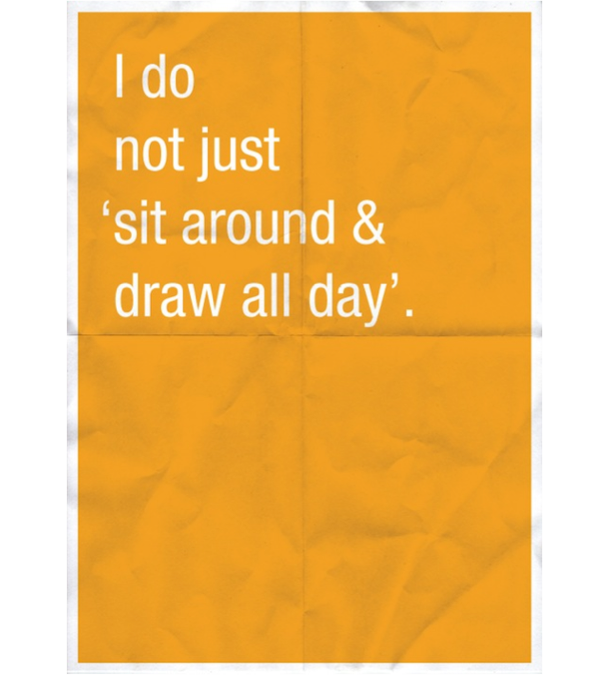
Earlier in the year I came across a fun post on designtaxi.com. It showed a set of posters developed by a London designer called Anneke Short which portrayed the frustrations and realities that designers often face. A frank and comical insight into the challenges for a designer in the creative process when it comes to briefing expectations and perceptions.

I thought it would be fun to show the client side perspective. So here it is - Confessions of a Corporate Professional, what really goes on in a Brand Managers Mind.


Designer
Client


Yes, as clients we need and love to see the corporate or product logo. We are obsessed with it. Deal with it. It gives us reassurance that the design concept will work and we can show it to senior execs. I have seen so many great ideas for packaging and/or advertising get thrown out just because the logo was not visible or treated with care.


Designer

Client


Clients are paying for concepts and ideas. We are hoping that you can come up with them fast so we can get a quick idea of whether one of them is 'on track'  to move forward for approval. After all, we have a lot of stakeholder expectations to manage. A lot of the time our internal colleagues don't know what they want or how to articulate what they need creatively.

Clients are often not open about their motivations when they make a request like this. They do not want to admit they do not know what they or their internal stakeholders are wanting.  A good client requests this when they are trying to get an understanding of what their internal clients want and will share this information up front with the agency. This leads to the point that often clients and agencies enter into the full creative process when really it would be better to explore ideas ...rarely this happens.


Designer
Client


A lot of clients are not experts in creative techniques, production, the concept of studio management or creative software. They have no idea how long something takes to do or how hard it may be. If you then take into account that this is multiplied by the fact that there are internal clients requesting creative work with even less knowledge of these considerations, expectations of efficiency and timings become clouded.

While clients often want 'what they ask for, when they want it',  it is still worth spending the time to explain or identify the process up front. Assisting clients to manage expectations with their internal stakeholders and educating them to be confident to talk about the process helps them be a good mediator when necessary. It will also help them to positively position the design expertise and convey processes.


Designer
Client


Most clients have little choice about the technology platforms they use. In fact in large corporations 'fitting in' rather than 'standing out' is expected to a degree. The ability to put business success first rather than personal agendas.

Believe me, creative people from agencies are often intimidating to clients because they are perceived to be cool trend setters.

We know what agency professionals think of us corporate clients .... we are like PC from the famous MAC and PC campaign. You see us as uptight predicable conformists. This makes us feel slightly awkward around you, because we need to be restrained and considered in our thinking, even if we want to be more daring.


Designer
Client


This would be very frustrating for a designer. You would be amazed at how many clients secretly think they are creative because they have software at hand. Good clients know what their role is in the creative process which revolves around project management, relationship building, influence and professional credibility.

Seriously would a client ever say 'I know my way around a spreadsheet, so send me the budget and I'll play around with it.' It is assumed that there is financial expertise and planning inputs which have been utilised to derive the final version. Yet we often devalue creative work by playing around the edges and losing sight of the discipline needed to produce outcomes.

Designer
Client


Again this perception would be frustrating for a designer. Here's where it comes from.  Clients and their internal stakeholders do not think conceptually or in creative terms most of the time. We spend our days talking about business and industry activities and challenges. So when a designer talks in creative cliches with little business language the perception is they have little understanding of professional realities.


Thank you to Anneke Short for putting these thoughts toghether. They made me smile as I have had the similar thoughts when dealing with internal stakeholders trying to brief me on their needs on client side.  I hope this helps put some perspective on client thinking.